Paul Bastard on looking at cancer through the lens of autoimmunity
Paul Bastard on looking at cancer through the lens of autoimmunity

Ludmil Alexandrov made his mark early. As a PhD student in the lab of Sir Mike Stratton, Ludmil developed the computational framework to identify mutational signatures and went on to define the repertoire of mutational signatures present in human cancer. Later, as a professor at the University of California San Diego School of Medicine, he was, he was an integral member of Mutographs, the Cancer Grand Challenges team that transformed understanding of how cancer starts.
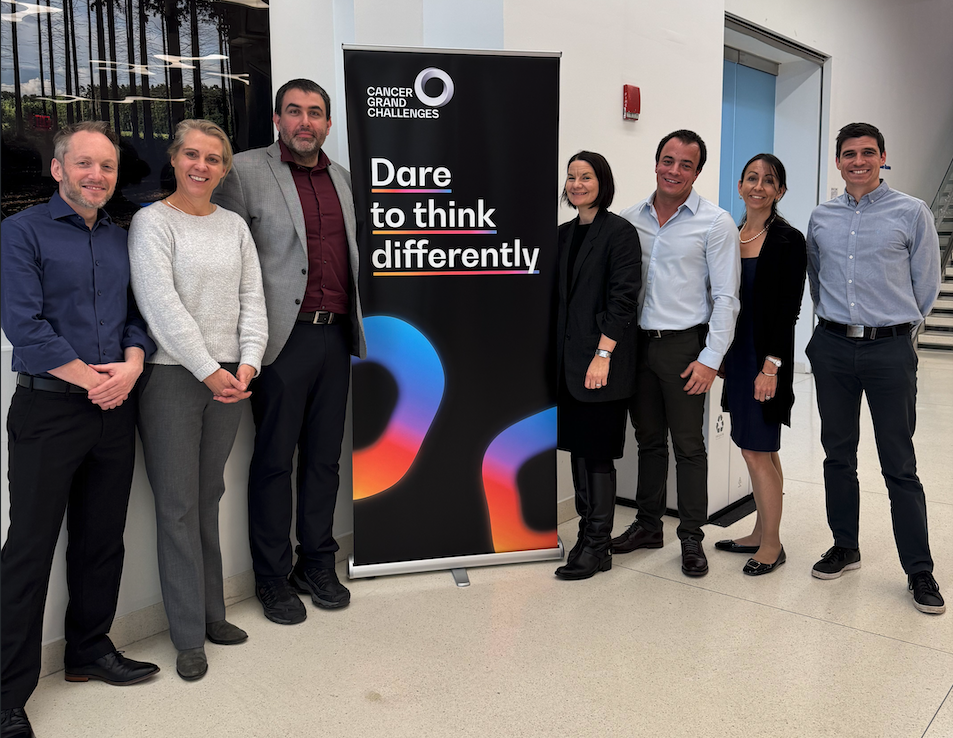
Mutographs pioneered a whole new field— mutational epidemiology— uncovering mutational signatures that have the potential to explain differences in global cancer incidence rates. Today, many dozens of distinct mutational signatures have been identified across human cancers, yet for most, we still don’t know what causes them. Ludmil is now the Team Lead of CAUSE, one of our newest funded teams, armed with up to $25m to address our mechanisms driving mutational signatures challenge. CAUSE hopes to bridge the gap between mutational signature and exposure, shifting the field from observational to actionable, potentially transforming cancer prevention.
Here, we go behind-the-scenes of Ludmil’s career, from computer science to cancer research, via an assisted living facility and a brief consulting career, and discuss his hopes for the legacy of team CAUSE as well as the “spidey sense” that comes with being on the verge of a big discovery.
Through Cancer Grand Challenges CAUSE is funded by Cancer Research UK, the US National Cancer Institute, and KWF (Dutch Cancer Society).
Wondering what a mutational signature is?! Read the plain language summary of team CAUSE’s approach.
I'm originally from Bulgaria, but my family immigrated to the US when I was 17. Even in high-school I was fascinated by computer science, so I went to do a bachelor's on that. Afterwards I actually worked in consulting for around two years, specialising in IT strategy. But to be completely frank, I found it quite boring. So, I applied to master’s programmes and went to the UK to study computational biology in Cambridge. The programme was a challenging mix. I knew nothing about biology at the time, but I had good computational skills to build on. I enjoyed that very much and so subsequently went to do my PhD at the Sanger Institute, working on cancer genomics.
When I was doing my bachelor's, I needed a full scholarship and also had to work while studying. In the evenings, I worked at a very nice assisted living facility. It was an exceptionally interesting experience to spend time with people near the end of their lives, many of whom had been extremely successful and wealthy. It made me realise that, at that stage of life, professional success and wealth often mattered much less than health, relationships, and whether you felt you had done something meaningful. That was a defining moment for me. I wanted to be able to look back and say that I had done something that mattered, rather than simply accumulated wealth or fame.
As scientists, I think we should keep that long-term perspective in mind. Papers, citations, and grants are important—they enable discovery—but they are not the end goal. The goal is to leave behind knowledge that remains valuable long after our careers are over.
Mike Stratton has been a defining influence on my career for two reasons. First, he was my PhD advisor, but at the time he had never supervised a computational student. He had always supervised students who were doing experiments, generating data. And I remember when I spoke to him, he said, “Well, we can do it, but it will be an experiment for me because I have no idea… I know what problem needs to be solved, but I don't know how you will solve it.” I found that very exciting because I was playing with the unknown.
Later in my career, through the Cancer Grand Challenges team Mutographs, which Mike led and I was a member of, I again saw his willingness to be bold and unconventional. For example, while everybody else was sequencing cancers, he was sequencing normal tissues. He had a clear vision, and that vision might or might not turn out to be correct, but I found his willingness to pursue something new and potentially transformative very inspiring.
It’s hard to describe. You get a “spidey sense” that you're touching something really cool, but it’s amorphous and you need to shape it. I've had a few of those moments, and some turned out to be real and some did not. The most notable example is mutational signatures. For about a year, we were talking about the signatures just between us in Mike’s group—we had this secret language. Even now, I find it amazing that people have picked up our secret language and are now using it in the literature.
It's an interesting question because even the name sounds daunting—a grand challenge. It’s a big responsibility and there is a substantial amount of money associated with it. I might have imagined it much later in my career, if everything went well, but certainly not at this stage. Having said that, when the challenge call came out for mechanisms driving mutational signatures, I felt that I had to apply.
The central idea behind CAUSE is that we need to work backwards. Rather than starting with mutations alone, we begin with DNA damage. By measuring DNA adducts directly, understanding how they are repaired, and determining the mutational signatures they generate, we can establish causal links between specific exposures and the mutations observed in human cancers. That is what makes CAUSE both challenging and exciting — it brings together chemistry, biology, genomics, and computational science to solve questions that none of these disciplines could answer on their own.
Ultimately, we hope to turn unexplained mutational signatures into identifiable causes and, where possible, preventable exposures. If we can understand what is damaging DNA long before cancer develops, that knowledge could enable entirely new approaches to cancer prevention.
Learn more about team CAUSE, including a plain language summary of the team’s approach.
Discover all five new teams and how they were selected.
Find the whole series on our news page: The stories behind the science.
Edited by Rebecca Eccles
Paul Bastard on looking at cancer through the lens of autoimmunity
Leanne Li on scientific liberation and creating scientific waves
Reuven Agami on curiosity, serendipity and the dark proteome