
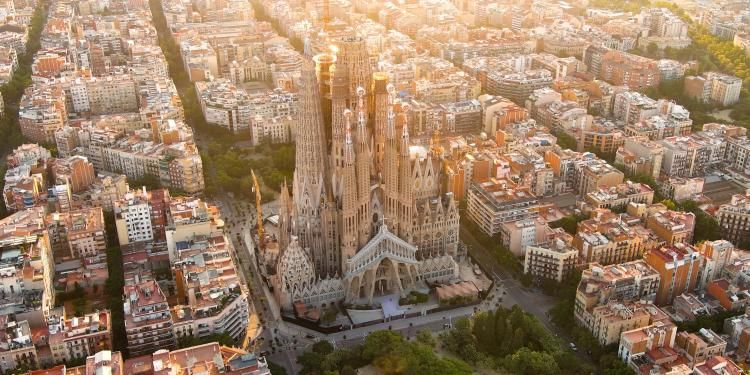
Future Leaders' Conference 2026
11 – 13 November 2026 | Novotel Barcelona, SpainCurrently viewing section: Welcome
Welcome
We are looking forward to hosting you in Barcelona, Spain, for the next Future Leaders' Conference!
Connect with your fellow early-career researchers from the global Cancer Grand Challenges community and share the latest advancements your team is making towards tackling its challenge. This year’s conference will focus on enabling collaboration and facilitating networking, and training.
The Cancer Grand Challenges Future Leaders' Conference is generously supported by The Bjorn and Inger Saven Future Leaders Fund.
Register below to secure your place!
As part of the form, you will be asked to provide your abstract title, author names and affiliations, and an abstract of up to 150 words.
Following registration, please email your photo to events@cancergrandchallenges.org.
Register by Friday 31 July
Future Leaders' reception
Join us on Thursday 12 November for a dedicated private reception at CosmoCaixa Museum of Science in front of the Flooded Forest. This immersive 1,000-square-meter greenhouse replicates a lush Amazonian rainforest ecosystem. You will get to observe tropical flora, piranhas, crocodiles, and other native species from both above and below the water level.
Keynotes and special sessions
Programme
The conference will start at 3.30pm on Wednesday 11 November, and end at 4pm on Friday 13 November.
More details will be announced in the coming weeks. Please note that the programme is subject to change.
1.30pm - 3.30pm - Registration
Registration will open at 1.30pm. Please use this time to put your poster up if you're presenting in the first session.
3.30pm - 4pm - Welcome to the Cancer Grand Challenges Future Leaders' Conference 2026
Blake Sanders, Research Portfolio Manager, Cancer Grand Challenges, UK
Talk: Àngel Font, Executive Director, CaixaResearch Institute, ES
CaixaResearch Institute, where the immunology shapes the future
4pm - 4.30pm - Networking session
Future Leaders' Conference Organising Committee:
- Alberto Guerra, Children's Hospital of Philadelphia, US
- Sefanie Ha, University of University of Würzburg, DE
- Roberta Ibba, University of Dundee, UK
- Debasmita (Debi) Mukherjee, University of Cambridge, UK
- Gianmarco Piccinno, University of Trento, IT
- Alice Wang, Cold Spring Harbor LaboratoRY, US
4.30pm - 5pm
Team Talk SPACE: Spatial Profiling and Annotation Centre of Excellence
Chair: TBC
Talk one: Giorgia Battistoni, Postdoctoral Researcher, University of Cambridge, UK
Illuminating Spatial Biology: Light-Driven Combinatorial Barcoding for Tunable Multi-Omic Profiling
Talk two: Tristan Whitmarsh, Postdoctoral Researcher, Institute of Astronomy, University of Cambridge, UK
An interactive spatial biology workbench for exploring cell segmentation and phenotyping methods
5pm - 5.45pm
Team talk eDyNAmiC: Understanding the role of extrachromosomal DNAs in cancer
Chair: Tanmay Mishra, PhD Student, Memorial Sloan Kettering Cancer Center, US
Talk one: Jordan Cobley, PhD Student, Queen Mary University of London, UK
Quantifying the evolutionary dynamics of extrachromosomal DNA using mutational distributions
Talk two: Aditi Gnanasekar, MD-PhD Student, Stanford University, US
Dynamic optimization of extrachromosomal DNA copy number drives tumour evolution
Talk three: Long Wang, Postdoctoral Researcher, Barts Cancer Institute, UK
Co-selection and fusion of extrachromosomal amplified MDM2 and other oncogenes in human cancers
5.45pm - 7pm - Poster session one
Learn more about the latest research the future leaders are working on to tackle their challenge. Presenters and abstracts available in the abstract booklet
7pm - 9pm - Welcome reception
Drinks and refreshments served at the Hotel Rooftop
8am - 9am - Breakfast
Buffet breakfast will be served in the hotel restaurant
9am - 9.45am
Team talk NexTGen: Developing novel therapies to target unique features in solid tumours in children
Chair: Jarrett Lindsay, Postdoctoral Researcher, Children's Hospital of Philadelphia, US
Talk one: Lara Engertsberger, Postdoctoral Researcher, Dana-Farber Cancer Institute, US
Multi-Ganglioside Targeting to Overcome Antigen Heterogeneity in Histone H3 Wildtype Pediatric High-Grade Glioma
Talk two: Lynne El Ghorayeb, Staff Scientist, Children's National Hospital, US
DEFEATing Pediatric Brain Tumors Through Newly Engineered and Optimized Dual-Target B7H3/GPC2 CAR T cells
Talk three: Grace Lui Jongyun, Staff Scientist, Children's National Hospital, US
Harnessing the Noncanonical Peptidome of Diffuse Midline Glioma for Adoptive T Cell Therapies
9.45am - 10.30am
Team talk CANCAN: Understanding cachexia and declining performance status in cancer patients
Chair: Debasmita Mukherjee, Postdoctoral Researcher, Cancer Research UK Cambridge Institute, University of Cambridge, UK
Talk one: Dimitria Brempou, Postdoctoral Researcher, University College London Cancer Institute, UK
Longitudinal plasma proteomic profiling of patients with cancer-associated cachexia in TRACERx
Talk two: Tuba Mansoor, PhD Student, Cold Spring Harbor Laboratory, UK
A tumor-derived PTHrP-calcium axis drives cardiac dysfunction to connect cancer cachexia with mortality
Talk three: Ethan Tse, PhD Student, Memorial Sloan Kettering Cancer Center, US
Tumour-host interactions shape the anatomic phenotypes of cancer patients
10.30 - 11am - Break
Tea, coffee and light refreshments, served in the hotel
11am - 1pm
Keynote talk: Oliver Bogler, CEO, Night Science Institute, US
Night Science - Where Breakthroughs Begin
1pm - 2pm - Lunch
Will be served in the hotel
2pm - 2.45pm
Team talk PROMINENT: Understanding unusual mutations patterns to identify unknown causes of the disease
Chair: Joan Enric Ramis Zaldivar, Postdoctoral Researcher, Institute for Research in Biomedicine, ES
Talk one: Christophe Goncalves, PhD Student, KTH Royal Institute of Technology, SE
Mapping the Hidden Landscape: Spatial Proteomics in Esophageal Heterogeneity
Talk two: George Richenberg, Postdoctoral Researcher, Imperial College London, UK
Genetically Predicted Interleukin-6 Inhibition and Pan-Cancer Risk
Talk three: Katrin Schmitt, Life Science Research Professional II, Stanford University, US
Proteomic signatures of colibactin exposure in tumor-adjacent colorectal tissue
2.45pm - Panel discussion
Introduction to the five new teams tackling cancer avoidance, the nervous system and cancer, the dark proteome, rewiring cancer cells, and mechanisms driving mutational signatures
Chair: Blake Sanders, Research Portfolio Manager, Cancer Grand Challenges, UK
Talk one: Alexis Maillard, MD-PhD Student, ATLAS, Institut Imagine, FR
A multiplex platform to investigate anti-cytokine autoantibodies in cancer
Talk two: Zicheng Yu, Postdoctoral Researcher, CAUSE, Institute of Genetics and Cancer, University of Edinburgh, UK
Generalised training for detection of non-canonical nucleotides in DNA by nanopore sequencing
Talk three: MacLean Sellars, Clinician Scientist, ILLUMINE, Dana-Farber Cancer Institute, US
Immune selective pressure by personal neoantigen-targeting vaccines shapes response in high-grade serous ovarian cancer
Talk four: Rémi Hudelle, Postdoctoral Researcher, InteroCANCEption, Swiss Federal Institute of Technology Lausanne, CH
Neuronal architecture of pancreatic ductal adenocarcinoma
Talk five: Jenny Xue, Postdoctoral Researcher, REWIRE-CAN, Memorial Sloan Kettering Cancer Center, US
Adaptive Mechanisms of Resistance to KRAS Inhibition in Colorectal Cancer
3.45pm - 4.30pm
Team talk KOODAC: Developing protein degradation approaches to target oncogenic drivers of solid tumours in children
Chair: Christina Michail, Postdoctoral Researcher, Institut Curie, FR
Talk one: Alberto Guerra, Clinician Scientist, Children's Hospital of Philadelphia, US
Targeting the anaplastic lymphoma kinase (ALK) oncoprotein with antibody-drug conjugates and cellular therapy platforms in neuroblastoma and ALK-expressing malignancies
Talk two: Jill Pilet, Postdoctoral Researcher, Institut Curie, FR
Oncogenic fusions induce an extensive cancer-restricted cryptic proteome in Ewing sarcoma
Talk three: Caroline Schätz, PhD Student, AITHYRA Research Institute for Biomedical Artificial Intelligence, AT
Induced Estrogen Receptor SUMOylation drives SERD activity
4.30pm - 6pm - Poster session two
Learn more about the latest research the future leaders are working on to tackle their challenge. Presenters and abstracts available in the abstract booklet
6pm - 7pm - Break
Drinks and refreshments served
7pm - 10pm - Networking reception at CosmoCaixa Museum of Science
Join us for a special networking evening at CosmoCaixa Science Museum, including a 30-minute museum tour followed by a drinks and canapés reception
Please meet in the hotel reception at 6.45pm. Coaches will depart shortly afterwards for the museum, approximately 20 minutes away
8am - 9am - Breakfast
Buffet breakfast will be served in the hotel restaurant
9am - 9.45am
Team talk PROSPECT: Investigating the global rise of colorectal cancers in younger adults
Chair: Mudita Goyal, PhD Student, Harvard University, US
Talk one: Madeline Edwards, Postdoctoral Researcher, Institut Pasteur, FR
Maternal high-fat diet reduces type 1 immune surveillance in offspring
Talk two: Muhammad Shah Zaib, PhD Student, University of Trento, IT
Multi-cohort metagenomic analysis of the gut microbiome in early-onset colorectal cancer
Talk three: Jack Sumner, Postdoctoral Researcher, Broad Institute, US
Identifying viral determinants of colorectal cancer
9.45am - 10.30am
Keynote talk: Mariam Jamal-Hanjani, co-investigator, CANCAN and eDyNAmiC, University College of London, UK
Lung Cancer Evolution and Metastasis Across Scales
10.30am - 11am - Break
Refreshments served in the hotel
11am - 11.45am
Team talk MATCHMAKERS: Understanding how T cells recognise cancer cells
Chair: Aleksei Titov, MD-PhD Student, Oslo University Hospital, NO
Talk one: Nick Chandler, Postdoctoral Researcher, Oslo University Hospital, NO
How to train MATCHMAKERS using odd-couples – Leveraging Allo-restricted TCR repertoires to train AI-powered predictions of TCR:pMHC pairings
Talk two: Julianne Lim, PhD Student, University of California San Francisco, US
Neuronal architecture of pancreatic ductal adenocarcinoma
Talk three: Kersten Heyer, PhD Student, Technical University of Munich, DE
Large scale structural modeling of thousands of murine epitope-reactive TCRs reveals common TCR-pMHC binding characteristics
11.45am - 12.45am
Collaboration session: Night Science
Oliver Bogler, CEO, Night Science Institute, US
12.45pm - 1.45pm - Lunch
Will be served in the hotel
2.45pm - 3pm - The finale
Awards and closing remarks
Blake Sanders, Research Portfolio Manager, Cancer Grand Challenges, UK
Frequently Asked Questions
No, there is no registration fee to attend the conference.
The cost of your travel should be covered by your Cancer Grand Challenges grant. Please book your travel as early as possible to secure the most economical rates and ensure bookings are made in line with your institution’s travel policy.
Please check the visa entry requirements for Spain as early as possible. This will help ensure there is sufficient time for us to support you if required.
If you require a visa support letter, please email events@cancergrandchallenges.org with the following information:
- Passport number
- Nationality
- Date of birth
- Passport issue date
- Passport expiration date
Yes. When you register to attend the conference, accommodation for the nights of Wednesday 11 November and Thursday 12 November will be booked by the Cancer Grand Challenges team.
The cost of accommodation is covered by the Cancer Grand Challenges team.
Yes. All attendees are required to submit an abstract to attend the conference.
You will be able to submit your abstract as part of the conference registration process.
If you would like to extend your stay, please email the hotel with the subject line "Cancer Grand Challenges Future Leaders ' Conference”. To secure the conference rate of €205 per night, please book by September 1 and note that bookings made past this date are subject to higher prices.
Future Leaders’ Conference 2026 Organising Committee
Code of conduct
Cancer Grand Challenges is dedicated to providing a welcoming, safe and inclusive environment for all who attend our research events. The Code of Conduct applies to all participants, including, but not limited to, attendees, speakers, exhibitors, Cancer Grand Challenges staff, and others.
By accepting a place at a Cancer Grand Challenges research event, you are expected to read and abide by this Code of Conduct for the duration of the event.