
Harnessing the microbiome to personalise colorectal cancer prevention, diagnosis and treatment
Could the microbiome be responsible?

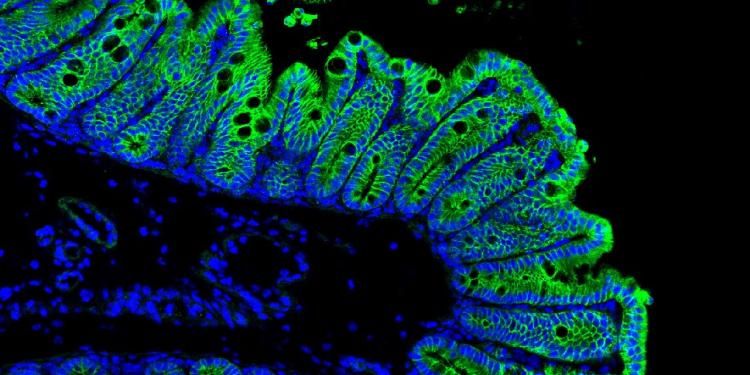
The OPTIMISTICC team tackled the microbiota challenge: understanding how the trillions of microorganisms that live in and on our bodies influence cancer. In a new study published in Nature, this international team of Cancer Grand Challenges researchers, supported by funding from Cancer Research UK and the Bowelbabe Fund for Cancer Research UK, have uncovered how a toxin produced by a common gut bacterium directly damages the lining of the colon, revealing a key molecular step that may contribute to colorectal cancer.
Here, we explore the findings from the study, which identify how a bacterial toxin latches onto human cells and triggers a cascade of events that disrupts the gut’s protective barrier. The work provides important insight into how the microbiome can actively drive disease, and points towards new strategies to prevent or block these harmful interactions. Ultimately, insights like these may pave the way for new strategies to detect, prevent and treat colorectal cancer by targeting the microbiome itself, although further studies will be needed to translate these findings into clinical approaches.
The human gut is home to a vast and complex ecosystem of microorganisms, bacteria, viruses and fungi, collectively known as the microbiota. For the most part, these microbes play essential roles in digestion, immunity and overall health. But over the past decade, there has been evidence that some members of this community can be linked to colorectal cancer. This raised a fundamental question for researchers: are these microbes simply associated with cancer, or can they actively drive it? Answering this question requires moving beyond correlation to begin uncovering the precise biological mechanisms at play. That is the challenge the OPTIMISTICC team set out to address.
One bacterium of particular interest is Bacteroides fragilis, a common resident of the human gut. Certain strains produce a toxin known as BFT (B. fragilis toxin), which has been shown to promote tumour formation in experimental models and is associated with colorectal cancer in humans. BFT has been shown to damage the cells lining the colon, triggering inflammation and increased cell growth, processes associated with cancer development. But despite its potent effects, exactly how this toxin interacts with human cells remained unclear.
Researchers knew that BFT binds to the surface of colon cells and causes the breakdown of E-cadherin, a crucial protein that helps neighbouring cells stick together, but the identity of the receptor it uses, and how this process is initiated, had remained elusive.
To uncover how BFT works, the team used a genome-wide CRISPR screen, a powerful technique that allows scientists to systematically switch off genes across the genome and observe the effects. Rather than looking for cells that survived the toxin, the researchers searched for cells that resisted one of its key effects: the loss of E-cadherin from the cell surface. This approach allowed them to pinpoint genes required for the toxin’s activity. One protein stood out clearly: claudin-4.
Claudin-4 is a component of tight junctions, structures that help seal neighbouring cells together and maintain the integrity of the gut lining. When the researchers removed claudin-4, cells became highly resistant to the toxin. When they restored it, sensitivity returned. This revealed that claudin-4 acts as the long-sought receptor for BFT, the molecular “handle” the toxin uses to engage with human cells.
Identifying the receptor was only part of the story. The next question was: what does this interaction actually do? The team discovered that binding to claudin-4 enables the toxin to carry out its damaging function. In effect, claudin-4 acts like a docking site that allows BFT to position itself correctly on the cell surface. Without this interaction, the toxin cannot efficiently act. But once bound, it gains the ability to target and cleave E-cadherin. This finding suggests an important principle: the toxin does not act alone, but instead relies on host cell machinery to become fully active.
E-cadherin plays a critical role in maintaining the structure of tissues by holding cells together, much like mortar between bricks. When BFT cleaves E-cadherin, this adhesive function is disrupted. The result is a breakdown of the epithelial barrier that lines the gut, a protective layer that normally prevents harmful substances and microbes from penetrating deeper into the tissue. This disruption can lead to, increased permeability of the gut lining, inflammation and abnormal cell proliferation. All of these processes are associated with tumour development The study shows that claudin-4 binding allows BFT to access and cut E-cadherin at the cell surface, effectively unlocking a pathway that may contribute to tissue damage and disease.
Understanding this mechanism also opens up new possibilities for intervention. The researchers showed that a soluble version of claudin-4, designed to mimic the natural receptor, can bind to the toxin and block its activity. In experimental models, this approach reduced tissue damage caused by BFT.
This suggests that targeting the interaction between the toxin and its receptor could represent a potential strategy to prevent damage to the gut lining and reduce inflammation, although further studies will be needed to determine whether this could ultimately lower cancer risk. Importantly, this approach could avoid some of the challenges associated with directly targeting the toxin’s enzymatic activity, offering a potentially more specific way to intervene.
While early hopes in the field envisioned a single microbe playing a role in colorectal cancer similar to HPV in cervical cancer, the reality is proving to be far more complex.
Instead of one clear-cut cause, the microbiome appears to influence cancer through a network of interactions between microbes and host tissues. This study provides an important piece of that puzzle, showing in molecular detail how one bacterial toxin can alter human cell behaviour. By uncovering how microbes interact with the body at this level, OPTIMISTICC is helping to move the field from observation towards a deeper mechanistic understanding, and potentially towards future intervention. Ultimately, insights like these may help guide future approaches to detect, prevent and treat colorectal cancer by targeting the microbiome itself, although further work will be needed to translate these findings into clinical practice.
Could the microbiome be responsible?
Common infection could be one driver of colorectal cancer rise in younger adults, according to findings from OPTIMISTICC.