
ATLAS
Led by Paul Bastard, Institute IMAGINEThe challenge
The ATLAS team is taking on the cancer avoidance challenge through the lens of immune-modulating autoantibodies, which may change the course of tumour biology. The team is exploring their role in cancer resistance by studying remarkable groups of people including: centenarians, people who have remained cancer-free despite high-risk exposures, and twins where one has had cancer and the other hasn’t. By uncovering what makes these people resistant, ATLAS’s work has the potential to change how we think about cancer formation and transform cancer prevention.
At a glance
ATLAS is funded by


Team and leadership
ATLAS is led by:
Paul Bastard, Institute IMAGINE
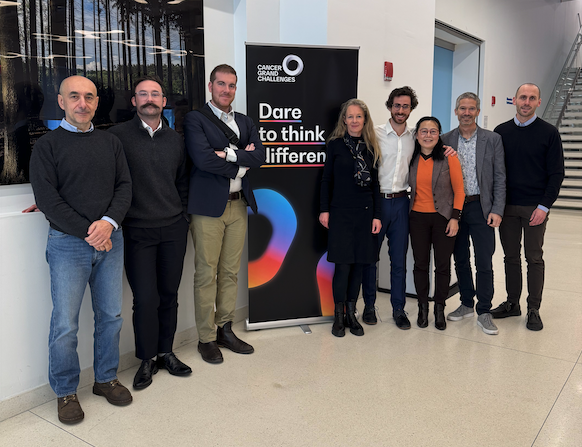
ATLAS includes the scientists behind breakthrough work linking autoantibodies and COVID-19 disease severity, and combines them with researchers and clinicians, with world-leading expertise in ageing, immunology, cancer biology and technology development.
Tackling the cancer avoidance challenge
Team ATLAS is exploring the role of immune-modulating autoantibodies in cancer resistance. The team will build on pioneering work from its members in identifying the link between autoantibodies and COVID-19 disease severity during the pandemic. Team members Paul Bastard and Jean Laurent-Casanova discovered autoantibodies present in those with life-threatening disease, which blocked the immune system’s ability to respond to the virus. These autoantibodies were very rare in infected individuals with no or mild symptoms.
Expanding on this groundbreaking work, the team hypothesise that cancer exists only with permission or avoidance of innate and adaptive immunity, and that immune recognition occurs whether the tumour is tolerated or destroyed. Leveraging the fact that memory of these immune responses - beneficial or detrimental - often remains in serum antibodies, the team will search for autoantibodies that may contribute to cancer avoidance.
To do this, the team will draw on large and well-characterised cohorts across diverse cancer types, ages and risk profiles, also including healthy young adult controls with very low risk of cancer. Extreme populations include centenarians, individuals who have remained cancer-free despite high-risk exposures, including excessive tobacco and alcohol consumption, those with genetic or metabolic predisposition or immune deficiency and twin pairs discordant for cancer.
The team will look for anti- and pro-tumour antibodies, as well as exposure-specific antibodies which correlate with cancer protection or susceptibility. Using advanced platforms such as proteome-scale antibody profiling technologies, the team will characterise antibody specificity and test their potential functional impact on immune responses and cancer-related pathways.
Looking ahead
The team’s work has the potential to change the way we think about immune surveillance in tumour formation, uncover novel tumour antigens and auto-antibody mediated immune errors that enable cancer development. Ultimately ATLAS’s work aims to provide new biomarkers and critically identify druggable mechanisms for both cancer prevention and treatment.

Plain language summary
One of the biggest challenges in cancer research is effective cancer prevention. Many studies focus on what actively causes cancer. However, we also need to understand how to use the body’s natural responses to prevent cancer from developing in the first place. Some people who are at high-risk never develop cancer. Similarly, despite the increase in cancer risk with age, some people live to be very old without developing cancer. How do these people avoid getting cancer? The ATLAS team thinks that antibodies may be part of the answer.
Imagine your body is a factory that builds and protects itself. Antibodies are like security guards. Their job is to patrol the factory and attack intruders like viruses and bacteria. An autoantibody is a confused guard who attacks the workers or machinery inside the factory instead of invaders, mistaking normal parts of the factory for threats.
The team plans to identify the presence of these autoantibodies which build on pioneering work from some of its research team. The pioneering work identified the presence of these autoantibodies in people with the most severe, often life-threatening, COVID-19 disease. These autoantibodies blocked important signals from the immune system preventing it from responding to the COVID-19 virus. It’s like the security guards attacked other members of the security team, allowing intruders to slip past and cause chaos. However, autoantibodies aren’t always harmful. In some cases, these security guards can also attack cancer cells. If they can recognise these traitors among the normal cells, they can remove cancer cells before they can grow or spread. But these security guards aren’t always successful, and this anti-cancer protection is not yet understood.
ATLAS will carry out the most thorough study to date of the role of antibodies in cancer and in cancer avoidance. In doing so, the team will generate a “Cancer Antibody Atlas”.
Antibodies remain present in the body after disease has gone, resulting in the body accumulating a collection of antibodies over the course of a lifetime. These antibodies correspond to the various diseases to which the person has been exposed. The team will make use of this memory and investigate antibodies present in the blood of unique human populations. These include extremely elderly people who have remained cancer-free and individuals with high-risk exposures who have not developed cancer. These high-risk exposures include excessive smoking and drinking. The team will also investigate individuals with genetic predispositions or immune deficiencies. In addition, the team will investigate twin pairs where only one has developed cancer, as well as cancer patients and healthy young adult controls.
Antibodies may play various roles in cancer. Pro-tumour antibodies may help cancer cells to avoid or to resist the immune system. Anti-tumour antibodies may help the immune system to recognise and attack the tumour. Other antibodies may not have a direct pro- or anti- cancer effect. However, they may be useful as “biomarkers” providing information about the chances of developing or avoiding cancer. ATLAS aims to identify the different types of antibodies involved in cancer, what they do and how they work.
The team’s work could reshape how we understand the immune system’s role in cancer development, leading to new ways to detect cancer cells and spot antibody errors. Ultimately ATLAS’s work will identify biomarkers and drug targets for both cancer prevention and treatment.